Tomodachi
Kensuke's KingdomTomodachi is an adult female orangutan and Kensuke’s favored companion. Through her, the novel presents the island’s animals as individual members of a community: she accepts Kensuke’s care, repeatedly seeks his company, and becomes a subject of Michael’s art. Her missing infant, Kikanbo, and the danger posed by hunters also make her a focus of the island’s shared vulnerability and of Kensuke’s protective responsibilities.
Identity and relationship with Kensuke
Kensuke’s relationship with Tomodachi is established through grooming. She often comes to sit by him, and while grooming her he deliberately plucks some of the longest, darkest hairs from her back. He later trims them and fits them into hollow bamboo, using tree sap as glue to make one of the paintbrushes with which he teaches Michael to paint. Tomodachi is thus not only a familiar presence beside Kensuke but, through a careful use of her shed and plucked hair, part of the practical material world he has made on the island.
Kensuke’s bond with the orangutans is expressed less through commands than through attention and familiarity. He can call them by singing, and they follow him through the forest. Tomodachi, in particular, approaches the cave house when she is distressed. Kensuke explains that she has lost track of Kikanbo again and calls the infant a troublesome baby who often runs off, leaving his mother sad. When he shoos Tomodachi away, she stays for a while, apparently seeking comfort; only after some time does she leave. The scene shows a relationship in which the animals come close to Kensuke when upset, while his knowledge of their habits allows him to respond to them as individuals.
Encounters with Michael
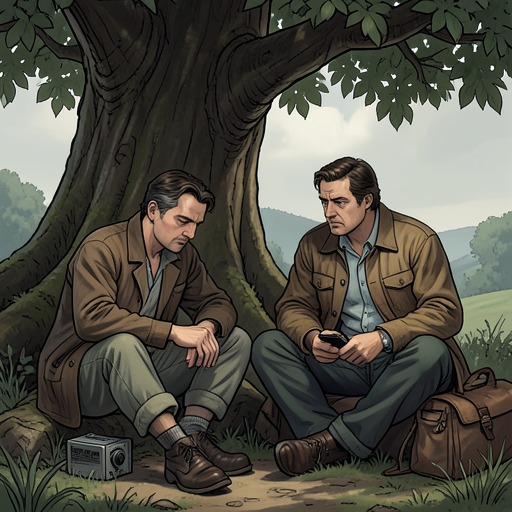
Tomodachi is present as Michael and Kensuke’s relationship develops. After Michael first reaches the island, Stella unexpectedly runs to greet Kensuke as though she knows him, rather than reacting with hostility. The scene marks the beginning of Michael’s discovery that Kensuke is already embedded in a community of animal relationships. Later, Tomodachi and the other orangutans accompany Kensuke and Michael through the forest, following them along the tracks and keeping near them, though the animals and the newcomers remain wary of one another at first.
Michael’s growing ease with the orangutans is illustrated by their physical curiosity. A young orangutan climbs onto his lap and examines his nose and ear; others follow, treating him like a climbing frame. The larger orangutans sometimes reach out to touch him, more cautiously. Tomodachi remains a distinct figure in the background of these encounters: her presence belongs to the group’s developing familiarity with Michael, even as Stella and the orangutans continue to keep some distance from one another.
Motherhood and recurring loss
Kensuke says that Tomodachi often loses Kikanbo, and that the infant’s habit of running off makes her sad. His comment gives the orangutans’ behavior an emotional dimension: the animals are not simply a group that follows Kensuke, but individuals whose attachments and distress he recognizes. Tomodachi’s visit to the cave during the night comes amid a period of silence between Michael and Kensuke, and her need to remain near him underscores the role he plays as a source of reassurance for the animals as well as a companion to Michael.
Kikanbo’s disappearance becomes consequential again when hunters approach the island. Kensuke gathers the orangutans by singing, and they appear in groups until the group numbers fifteen; four are initially missing, then three more arrive, including Tomodachi. Kikanbo is still absent. Kensuke sings for him repeatedly in a forest clearing, but the sound of an outboard motor means they cannot wait indefinitely. The urgency puts the animals’ safety and the search for Tomodachi’s infant in direct tension.
The hunters’ raid and its aftermath
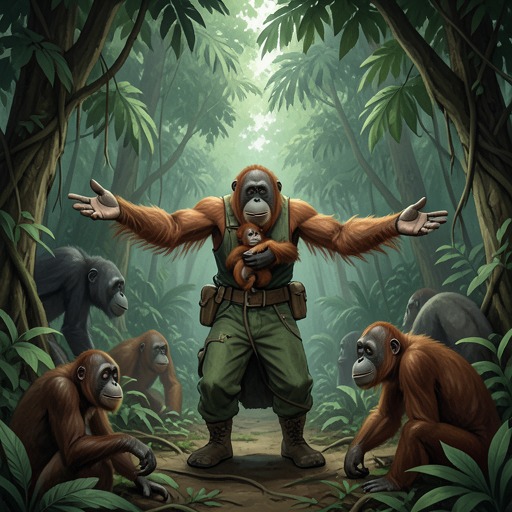
When the hunters reach the island, Kensuke brings the orangutans into the cave for protection. Tomodachi is the most agitated of the group. The orangutans need continued reassurance, and Kensuke sings softly to them while shots and shouting draw nearer. The account makes Tomodachi’s alarm one part of the animals’ shared fear, while Michael and Stella also remain with the group in the cave. After the hunters leave, Kensuke and Michael search and call for Kikanbo, but find no sign of him at first.
The search’s outcome brings relief without erasing the raid’s losses. Kensuke and Michael find the bodies of two dead gibbon mothers and bury them; Kensuke is deeply distressed. As they make their way back along the beach, Kikanbo suddenly emerges from the trees, runs to Kensuke, and climbs up his leg to his neck. His return reunites him with Tomodachi’s family and gives the island community a moment of joy after the hunters’ violence. That night, Kensuke and Michael sing “Ten Green Bottles” repeatedly, both as a kind of wake for the dead gibbons and in celebration of Kikanbo’s return.
Narrative significance
Tomodachi links several strands of the island story: Kensuke’s practical ingenuity, his close knowledge of the orangutans, Michael’s gradual entry into their world, and the danger that hunters pose to that community. The paintbrush made with her hair connects animal companionship to the art lessons through which Kensuke and Michael grow closer. Her visits when distressed show that care on the island flows across species, rather than belonging only to the human relationship between the two characters.
Her role also sharpens the stakes of the hunters’ arrival. The orangutans’ safety depends on Kensuke’s ability to recognize danger, gather them, and shelter them, while Kikanbo’s absence prevents that rescue from feeling complete until he returns. Tomodachi is not given an independent narration, but her behavior repeatedly changes the emotional texture of events: she seeks comfort, is unsettled during the raid, and stands at the center of the family group whose survival Kensuke works to protect.